

New York Has Raised Overtime Salary Thresholds in 2026
.jpg)


.svg)

New York State has announced updated salary thresholds for overtime exemptions that took effect on January 1, 2026.
These changes impact how employers classify certain salaried employees as exempt or non-exempt under New York labor law. Employers should review current classifications to ensure compliance with the revised thresholds and applicable duties tests.
Overview of Overtime Exemption Requirements
To classify an employee as exempt from overtime under New York law, employers must satisfy two separate criteria:
1. Salary Basis and Salary Threshold Test – The employee must earn at least the minimum required salary.
2. Duties Test – The employee’s primary job duties must meet the standards for an executive, administrative, or professional exemption.
Failure to meet either requirement results in the employee being classified as non-exempt and therefore eligible for overtime pay.
Updated Salary Thresholds for 2026
Effective January 1, 2026, New York increased the minimum salary thresholds for the executive and administrative exemptions. The required salary levels vary by geographic region.
Weekly and Annual Salary Thresholds
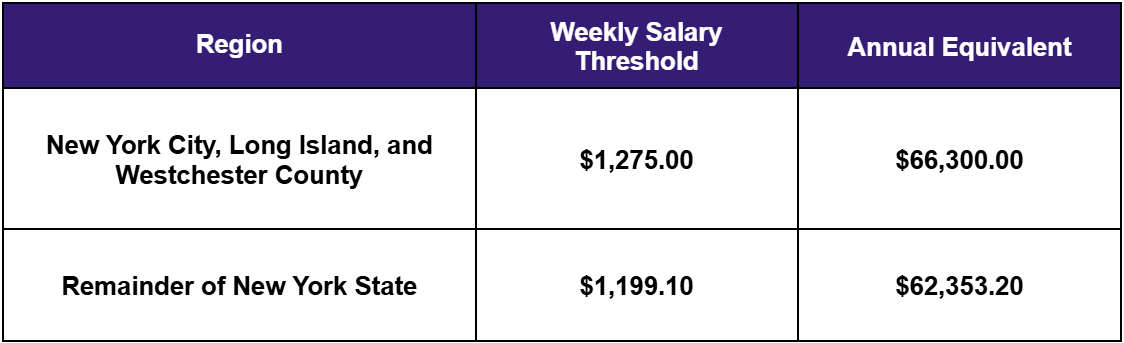
These thresholds represent an increase from 2025 levels and will require employers to evaluate whether currently exempt employees continue to qualify under the new salary standards.
Professional Exemption and Federal Standards
Unlike the executive and administrative exemptions, New York does not impose a state-specific salary threshold for the professional exemption. Instead, employers must follow the federal Fair Labor Standards Act (FLSA) salary requirement.
As of the most recent guidance, the federal minimum salary threshold for the professional exemption remains $684 per week ($35,568 annually), provided the employee meets the applicable professional duties test.
What This Means for Employers
The 2026 salary threshold increases may require employers to take one or more of the following actions:
- Increase salaries for employees currently classified as exempt
- Reclassify employees as non-exempt and begin tracking overtime hours
- Update payroll and time-tracking systems
- Review and revise job descriptions to confirm alignment with exemption duties tests
- Train HR personnel and managers on overtime eligibility requirements
Employers should also be mindful that misclassification can result in liability for unpaid overtime, penalties, and interest.
Employers must also begin reviewing exempt classifications. Conducting internal audits and consulting with payroll or employment law professionals can help identify potential compliance gaps and reduce risk.
Navigating evolving overtime exemption requirements is much easier with experienced payroll support. Contact Brand’s Payroll to learn how our services can support your business.
Related News

Employers in New York City and New Jersey should be aware of recent changes to employee leave requirements and job protections.

It’s always a good time to step back and make sure your payroll records still reflect what’s actually going on in your business.
Brand’s Insights Have That Effect.
You’ve made it this far—why stop now? Subscribe for more payroll and HR tips that actually help your business run smoother.
Ave #101 Brooklyn, NY 11205-1080

.svg)
.svg)
- Hospitality
- School/Education
- Property Management
- More coming soon
.svg)
.svg)


